U.S.S. Batfish - Oklahoma
U.S.S. Batfish - In Depth
A Submarine on Land
The U.S.S. Batfish now rests on
dry land in Muskogee,
Oklahoma, but once was the
champion "submarine killing"
sub of World War Two.
The U.S.S. Batfish now rests on
dry land in Muskogee,
Oklahoma, but once was the
champion "submarine killing"
sub of World War Two.
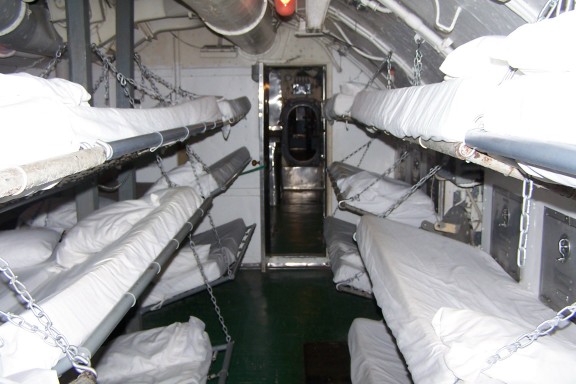
Cramped Quarters
Visitors to the Batfish can now
explore the inside of the boat and
see first hand how U.S. Navy
sailors lived and worked from
1943-1945 when the submarine
was a significant American
weapon.
Visitors to the Batfish can now
explore the inside of the boat and
see first hand how U.S. Navy
sailors lived and worked from
1943-1945 when the submarine
was a significant American
weapon.
Rightfully dubbed the champion "Submarine Killing" submarine of World War Two,
the U.S.S. Batfish sunk three enemy submarines within 76 hours. It was the
greatest single sub vs. sub accomplishment of the war and set a record that has
never been surpassed.
Today, the Batfish rests on the banks of a river adjacent to the Port of Muskogee,
but from 1943-1945 she was one of the most successful submarines ever
launched by the U.S. Navy.
The submarine service of World War Two was far more dangerous than can
possibly be imagined. Fifty-two submarines went down during the war, costing the
lives of 3,505 American servicemen. In the end, though, they played a vital role in
ending Japan's threat on the seas and helping to assure ultimate allied victory
over the Axis forces.
The Batfish was commissioned at Portsmouth, New Hampshire, and took the
name of a West Indian fish noted for its ferocity. With an overall length of 312 feet,
she displaced 1,465 tons and included an armament of 10 torpedo tubes as well
as deck guns. In combat, she fired 71 torpedoes scoring 24 hits and sinking 15
enemy ships.
The submarine departed Pearl Harbor on its first war patrol on December 11,
1943. Cruising off Honshu, Japan, she damaged two freighters and sank the
cargo ship Hidaka Maru before arriving at Midway on January 30, 1944.
Returning to sea on February 22, 1944, she patrolled for 53 days before returning
with no opportunity for combat. The submarine's third patrol, however, was much
more successful. Leaving Pearl Harbor on May 26, 1944, the Batfish approached
the coast of Japan south of the cities of Shikoku, Honshu and Kyushu. She sank a
Japanese training vessel and two cargo ships with patrols before surfacing and
sinking a trawler and its escort vessel with deck gun fire.
The fourth and fifth patrols reported similar results, including the sinking of
several Japanese destroyers. It was the sixth patrol, however, that achieved
lasting fame for the submarine. In 76 hours, the Batfish attacked and sank three
Japanese submarines. No other submarine has since duplicated this feat.
The Batfish made her final patrol in 1945. After shelling the coast of Japan, she
rescued three downed American aviators and returned to Midway on August 22,
1945. Her war role over, she returned to the United States a short time later.
In total, Oklahoma's submarine and her crew were awarded with 10 Bronze Star
Medals, 9 Battle Stars, 4 Silver Stars, one Navy Cross and One Presidential Unit
Citation.
Decommissioned for the final time in 1969, the Batfish was struck from the Navy
List on February 28, 1972. She arrived at the Port of Muskogee on May 7, 1972,
where she now rests on dry land as a permanent memorial to the American
submarine fleet and the men who served beneath the waves.
the U.S.S. Batfish sunk three enemy submarines within 76 hours. It was the
greatest single sub vs. sub accomplishment of the war and set a record that has
never been surpassed.
Today, the Batfish rests on the banks of a river adjacent to the Port of Muskogee,
but from 1943-1945 she was one of the most successful submarines ever
launched by the U.S. Navy.
The submarine service of World War Two was far more dangerous than can
possibly be imagined. Fifty-two submarines went down during the war, costing the
lives of 3,505 American servicemen. In the end, though, they played a vital role in
ending Japan's threat on the seas and helping to assure ultimate allied victory
over the Axis forces.
The Batfish was commissioned at Portsmouth, New Hampshire, and took the
name of a West Indian fish noted for its ferocity. With an overall length of 312 feet,
she displaced 1,465 tons and included an armament of 10 torpedo tubes as well
as deck guns. In combat, she fired 71 torpedoes scoring 24 hits and sinking 15
enemy ships.
The submarine departed Pearl Harbor on its first war patrol on December 11,
1943. Cruising off Honshu, Japan, she damaged two freighters and sank the
cargo ship Hidaka Maru before arriving at Midway on January 30, 1944.
Returning to sea on February 22, 1944, she patrolled for 53 days before returning
with no opportunity for combat. The submarine's third patrol, however, was much
more successful. Leaving Pearl Harbor on May 26, 1944, the Batfish approached
the coast of Japan south of the cities of Shikoku, Honshu and Kyushu. She sank a
Japanese training vessel and two cargo ships with patrols before surfacing and
sinking a trawler and its escort vessel with deck gun fire.
The fourth and fifth patrols reported similar results, including the sinking of
several Japanese destroyers. It was the sixth patrol, however, that achieved
lasting fame for the submarine. In 76 hours, the Batfish attacked and sank three
Japanese submarines. No other submarine has since duplicated this feat.
The Batfish made her final patrol in 1945. After shelling the coast of Japan, she
rescued three downed American aviators and returned to Midway on August 22,
1945. Her war role over, she returned to the United States a short time later.
In total, Oklahoma's submarine and her crew were awarded with 10 Bronze Star
Medals, 9 Battle Stars, 4 Silver Stars, one Navy Cross and One Presidential Unit
Citation.
Decommissioned for the final time in 1969, the Batfish was struck from the Navy
List on February 28, 1972. She arrived at the Port of Muskogee on May 7, 1972,
where she now rests on dry land as a permanent memorial to the American
submarine fleet and the men who served beneath the waves.
 | |  | |  | |  |