

The Battle of Devil's Backbone, Arkansas
Battle of Devil's Backbone - Confederate Reports
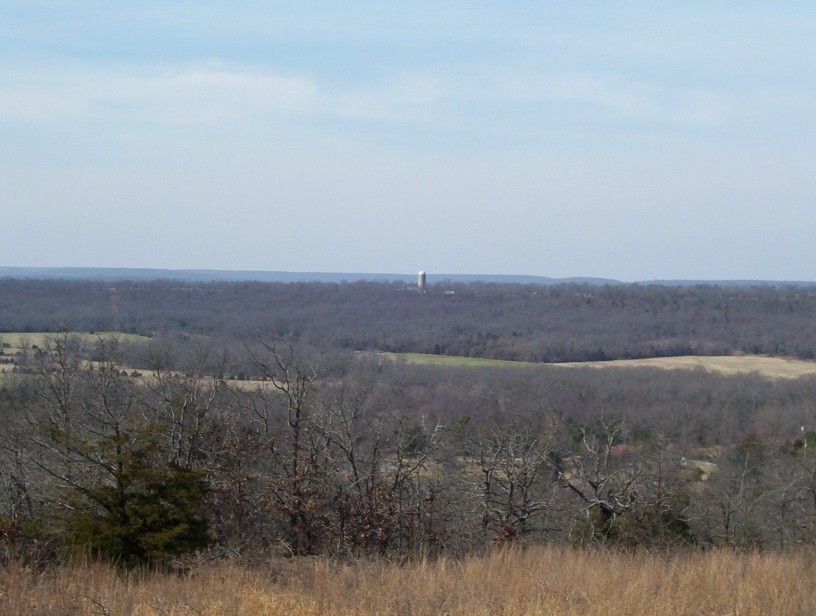
Battlefield at Devil's Backbone
The view from the top of Devil's
Backbone, looking out across
the approach route of the Federal
force and scene of the ambush
at the bottom of the ridge.
The view from the top of Devil's
Backbone, looking out across
the approach route of the Federal
force and scene of the ambush
at the bottom of the ridge.
CONFEDERATE REPORTS
Headquarters Cabell’s Brigade
December 7, 1863
Report of Brig. Gen. W.K. Cabell, C.S. Army, including operations July 17-September
14.
“About 9 p.m. on the 31st, I determined to fall back, if possible, to Waldron, in Scott
County. The baggage trains were all ordered to a little place called Jenny Lind, 10
miles on that road, early in the day. As soon as I commenced falling back, taking the
Jenny Lind road, I sent and started the train. The ordnance train, which was an ox
train, I had previously sent to Waldron.
“General Blunt, finding out that I had abandoned the position I had on the Poteau,
sent Colonel Cloud, with 1,500 cavalry, six pieces of artillery, and 40 wagons, loaded
with infantry, in pursuit of me. They followed, and attacked the picket I left at Jenny
Lind about 9 o’clock on the 1st day of September. The picket skirmished with their
advance until they reached the foot of Backbone Mountain, about 16 miles from Fort
Smith, where I had formed my command for battle. I placed Monroe’s regiment in
ambush at the foot of the mountain, and placed all the different regiments en
echelon along the sides of the mountain, near the road; the battery being placed so
as to command the whole field of operations. The enemy came dashing up, yelling
and shouting, confident of success, their cavalry in advance. When they came within
gunshot, Monroe’s regiment opened fire on them, and dismounted every man except
two in the front companies. The action soon became general, and, after a heavy fire
of nearly three hours and a half, especially of artillery, the enemy were repulsed…. My
loss was 5 killed and 12 wounded. The number of missing I cannot state, as eight
companies of Morgan’s infantry regiment, Hill’s and Thomson’s regiments, and
Woosley’s battalion of cavalry ran in the most shameful manner. Hill’s regiment, in
running, ran through the provost guard, where I had 80 prisoners under sentence for
treason and desertion. These men in running carried all the prisoners off with them.
Thomson’s and Hill’s regiments acted in the most disgraceful manner. The eight
companies of Morgan’s regiment acted but little better. There was nothing to make
these regiments run, except the sound of the cannon. Had they fought as troops
fighting for liberty should, I would have captured the whole of the enemy’s command,
and gone back to Fort Smith, and driven the remainder of the enemy’s force off, and
retaken the place. As it was, I was forced, on account of the smallness of my force, to
content myself with repulsing the enemy and protecting the public property. Leaving a
party to bury the dead and take off the wounded, I, after posting a heavy picket on the
battle-field, withdrew in good order, and marched to Waldron, Scott County, arriving
there on the 2d of September.”
Official Records, Series 1, Volume XXII, Part One, pages 606-607.
Headquarters Cabell’s Brigade
December 7, 1863
Report of Brig. Gen. W.K. Cabell, C.S. Army, including operations July 17-September
14.
“About 9 p.m. on the 31st, I determined to fall back, if possible, to Waldron, in Scott
County. The baggage trains were all ordered to a little place called Jenny Lind, 10
miles on that road, early in the day. As soon as I commenced falling back, taking the
Jenny Lind road, I sent and started the train. The ordnance train, which was an ox
train, I had previously sent to Waldron.
“General Blunt, finding out that I had abandoned the position I had on the Poteau,
sent Colonel Cloud, with 1,500 cavalry, six pieces of artillery, and 40 wagons, loaded
with infantry, in pursuit of me. They followed, and attacked the picket I left at Jenny
Lind about 9 o’clock on the 1st day of September. The picket skirmished with their
advance until they reached the foot of Backbone Mountain, about 16 miles from Fort
Smith, where I had formed my command for battle. I placed Monroe’s regiment in
ambush at the foot of the mountain, and placed all the different regiments en
echelon along the sides of the mountain, near the road; the battery being placed so
as to command the whole field of operations. The enemy came dashing up, yelling
and shouting, confident of success, their cavalry in advance. When they came within
gunshot, Monroe’s regiment opened fire on them, and dismounted every man except
two in the front companies. The action soon became general, and, after a heavy fire
of nearly three hours and a half, especially of artillery, the enemy were repulsed…. My
loss was 5 killed and 12 wounded. The number of missing I cannot state, as eight
companies of Morgan’s infantry regiment, Hill’s and Thomson’s regiments, and
Woosley’s battalion of cavalry ran in the most shameful manner. Hill’s regiment, in
running, ran through the provost guard, where I had 80 prisoners under sentence for
treason and desertion. These men in running carried all the prisoners off with them.
Thomson’s and Hill’s regiments acted in the most disgraceful manner. The eight
companies of Morgan’s regiment acted but little better. There was nothing to make
these regiments run, except the sound of the cannon. Had they fought as troops
fighting for liberty should, I would have captured the whole of the enemy’s command,
and gone back to Fort Smith, and driven the remainder of the enemy’s force off, and
retaken the place. As it was, I was forced, on account of the smallness of my force, to
content myself with repulsing the enemy and protecting the public property. Leaving a
party to bury the dead and take off the wounded, I, after posting a heavy picket on the
battle-field, withdrew in good order, and marched to Waldron, Scott County, arriving
there on the 2d of September.”
Official Records, Series 1, Volume XXII, Part One, pages 606-607.
 | |  | |  | |  | |  |
The Battle of
Massard Prairie
Massard Prairie
by Dale Cox
The first full-length account of
the 1864 Confederate attack on
Fort Smith, Arkansas.
the 1864 Confederate attack on
Fort Smith, Arkansas.
$19.95